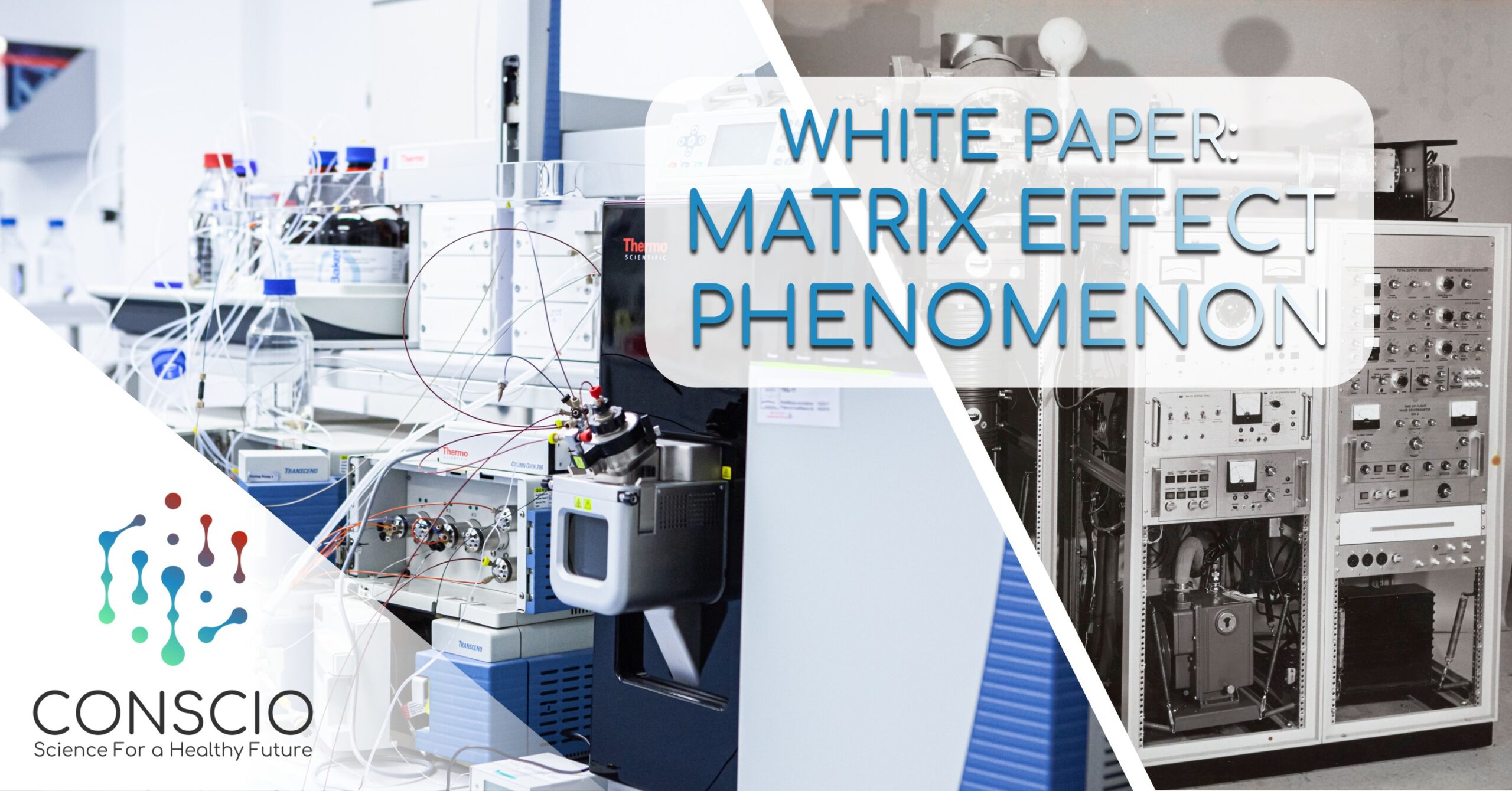
The matrix effect, defined as the alteration or interference in response due to the presence of unintended analytes or other interfering substances in the sample, remains a crucial phenomenon in bioanalytical determination using high-performance liquid chromatography tandem mass spectrometry methods (HPLC-MS). The original publication “How to Deal with the ‘Matrix Effect’ as an Unavoidable Phenomenon” was published in the European Journal of Mass Spectrometry in 2015[1]. Its author, Dr. Miroslav Ryska, is the founder of Quinta-Analytica, part of Conscio Group in the Czech Republic, and a renowned expert in mass spectrometry.
History and Significance
The matrix effect is not a new phenomenon, but its importance in bioanalytical methods continues to grow. The first observation of the matrix effect was recorded during chemical ionization in gas chromatography/mass spectrometry (GC-MS). With the development of technologies such as Atmospheric Pressure Chemical Ionization (APCI) and Electrospray Ionization (ESI), the matrix effect has become even more relevant, especially in the context of the high sensitivity and accuracy required in modern bioanalytical applications.
The concept of the matrix effect emerged from early chromatography experiments using conventional detectors like UV/VIS and flame ionization detectors (FID). Researchers noticed that different sample matrices contained interfering compounds that could affect detector responses. However, the primary concern at that time was the presence of coeluting compounds giving similar detector responses, rather than altering the detector response of the analyte itself. The coupling of liquid chromatography with mass spectrometry (LC-MS) marked a significant advancement. This combination allowed for the effective analysis of polar and thermally unstable compounds, overcoming the limitations of previous detectors. Key developments in this area were made with the introduction of atmospheric pressure ionization (API) and ESI interfaces. It is therefore not surprising that John Fenn’s development of the ESI technique was particularly groundbreaking, earning him the Nobel Prize in Chemistry in 2002.
The matrix effect has a profound impact on bioanalytical methods, particularly those involving the determination of drugs and metabolites in biological fluids. It can affect key validation parameters such as the limit of quantification, precision, accuracy, and selectivity. As a result, considerable attention has been paid to understanding and mitigating this phenomenon.
Modern Solutions to Matrix Effect
The use of isotopically labeled internal standards (IS) remains the most effective approach for compensating for the negative effects of the matrix effect, particularly in mass spectrometry. This strategy has been validated in numerous studies and is widely accepted by regulatory agencies such as the FDA and EMA.
Isotopically labeled internal standards are compounds in which several atoms within the molecule are replaced with stable (non-radioactive) isotopes, such as deuterium (²H or D), carbon-13 (¹³C), or nitrogen-15 (¹⁵N).
Two main advantages of isotopically labeled ISs are:
- Chemical Similarity:The chemical behavior of isotopically labeled molecules is nearly identical to their unlabeled counterparts. This similarity ensures that the labeled IS undergoes the same chemical reactions and ionization processes as the analyte under investigation, providing accurate compensation for matrix effects.
- Mass Difference:The higher mass afforded by the isotopes makes these analogs ideal internal standards for chromatographic methods using mass spectroscopic detection. A suitable mass difference between the analyte and the IS ensures that there is no spectral overlap, which is critical for precise quantification.
These advantages make isotopically labeled ISs a highly effective tool for reducing matrix effects, including ion suppression or enhancement, in LC-MS/MS assays. By compensating for matrix-related variability, they support accurate and reproducible quantification of drugs and metabolites in biological samples, particularly in pharmacokinetic and metabolism studies.
Additional Contributors to Matrix Effect and Its Mitigation
Although isotopically labeled internal standards remain the primary strategy for compensating for matrix effects, they do not address all factors contributing to this phenomenon. Other contributors, such as adsorption phenomena within the chromatographic system and/or ion source, may also significantly affect analytical performance. [2]
Because these effects cannot be fully eliminated, continued progress depends on technological refinement. In this respect, advances such as ultraperformance liquid chromatography (UPLC), two-dimensional chromatography, and optimized ionization modes have helped minimize matrix effects and improve analyte ionization efficiency. The use of strong Brønsted acids or bases may further enhance this process.
The integration of chromatography with MS has revolutionized analytical chemistry. LC-MS/MS combines the separation capabilities of chromatography with the detection power of MS, providing highly sensitive and specific analysis of complex mixtures.
Practical Applications and Future Directions
In recent years, attention has increasingly been paid not only to minimizing the matrix effect but also to understanding and, where possible, utilizing related phenomena to improve analytical methods. For example, specific adsorption phenomena can be used to enhance detection sensitivity for certain analytes.
The matrix effect is particularly relevant in pharmacokinetic studies, where accurate quantification of drug concentrations in biological fluids is essential. Isotopically labeled internal standards help ensure reliable measurements, which are crucial for determining drug absorption, distribution, metabolism, and excretion (ADME) profiles.
The matrix effect is also a concern in food safety and quality control, where accurate detection of contaminants, additives, and residues is essential. Advanced chromatographic methods, together with isotopically labeled standards, help ensure the reliability of these analyses.
Future advances in chromatographic technologies will most likely focus on enhancing sensitivity and selectivity. This includes optimizing ionization modes, developing new ion sources, and improving sample preparation techniques to reduce matrix effects and improve detection limits. Research into new stationary-phase materials, such as core-shell particles and monolithic columns, also continues to progress. These materials offer improved mass transfer properties and reduced backpressure, thereby enhancing the efficiency and selectivity of chromatographic separations.
The growing emphasis on sustainable and green chemistry will also drive the development of more environmentally friendly chromatographic methods. This may include reducing solvent consumption, using biodegradable materials, and implementing energy-efficient technologies.
Conclusion
The matrix effect remains a relevant and important phenomenon in bioanalytical determination using mass spectrometry. However, advances in technologies and methods for compensating for matrix effects continue to improve the accuracy and reliability of bioanalytical measurements, which is crucial for the development of new drugs and other applications in medicine and science. At Conscio Group, we continue to build on this expertise by upholding high scientific standards in the development and application of bioanalytical methods.
Sources
[1] M. Ryska, Eur. J. Mass Spectrom. 21, 423–432 (2015)
[2] The essence of Matrix effects for chromatographic assays